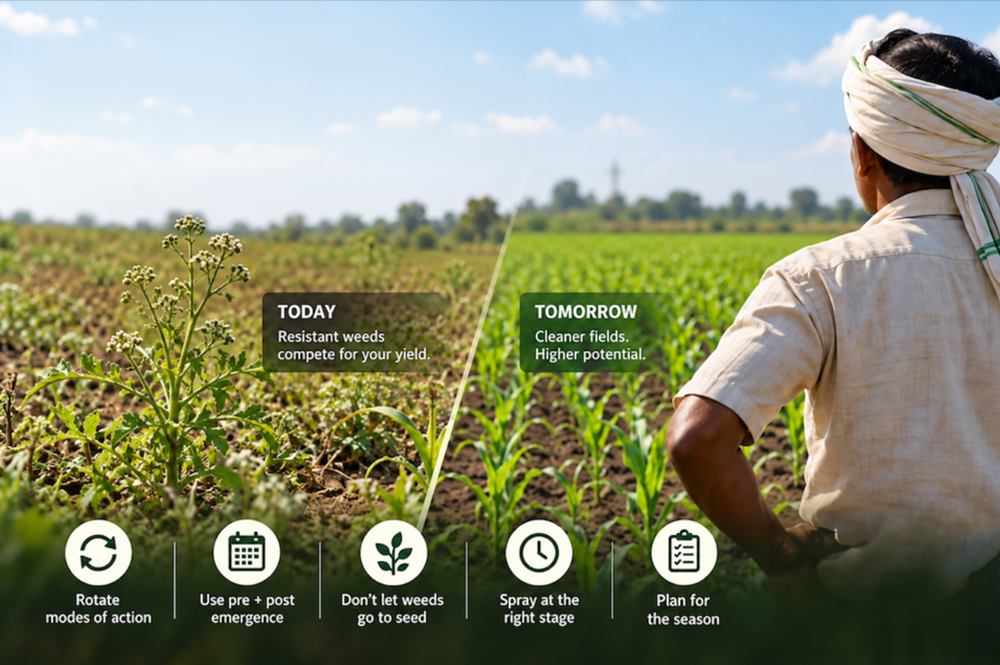

Weed Resistance Management: A Practical Guide for Indian Farmers

GSP Crop Science Blog | For farmers & dealers | 6min read
Herbicide-resistantweeds are one of the quietest yield thieves in Indian agriculture. They don'tannounce themselves the way a pest outbreak or a disease patch does — there'sno sudden visible damage to alert you. Instead, a resistant weed populationsimply keeps competing for nutrients, water and light, season after season,quietly pulling down the yield a field should be capable of.
Thegood news is that weed resistance is manageable with a few consistent habits —most of which cost nothing extra beyond planning ahead.
How Resistance ActuallyBuilds
Themechanism is the same one behind pest resistance: using the same herbicide, ormore precisely the same mode of action, every season selects for the smallfraction of weeds that can naturally tolerate it. Those survivors set seed, andtheir offspring inherit that tolerance. Repeat the same herbicide program forseveral seasons, and what started as a minor tolerant patch can become thedominant weed population in that field.
Thisis why farmers sometimes describe a herbicide that used to work well as 'goingweak' over the years — the product hasn't changed, but the weed population it'sup against has.
Three Habits That Slow It Down
• 1. Rotate modes ofaction, not just brand names. Twoproducts with different brand names can still share the same underlying mode ofaction. Check the active ingredient and mechanism, not just the label design,before assuming you've rotated.
• 2. Combinepre-emergence and post-emergence applications. Relying on a single application window gives anyescapees a full season to establish and set seed. A pre-emergence base plus apost-emergence follow-up closes that gap.
• 3. Don't let weeds goto seed, even in a written-off patch. Afield corner or a patch that seems not worth treating this season can reseedthe entire field the following year. One missed patch is next season's infestation.
Getting Timing Right
Post-emergenceherbicides are most effective at a specific weed growth stage — commonly the 2to 4 leaf stage for most broadleaf weeds, though this varies by species andproduct. Spraying too late, after weeds have hardened past this window, is thesingle most common reason a genuinely effective herbicide gets blamed for 'notworking.' The chemistry didn't fail; the timing did.
Weathermatters too. Rain shortly after a post-emergence application can wash off acontact-action herbicide before it's absorbed, and spraying during the hottestpart of the day can cause fast evaporation that reduces uptake. Early morningor late afternoon applications, away from peak heat, generally perform better.
A Simple Season Checklist
• Identify the dominantweed species in the field before choosing a product — not all herbicides targetthe same weed spectrum.
• Confirm the mode ofaction used last season and choose a different one this season if repeating thesame field.
• Plan a pre-emergenceplus post-emergence combination rather than a single application.
• Spray at the correctweed growth stage, not on a fixed calendar date.
• Walk field edges and'low priority' patches before harvest to catch weeds that have gone to seed.
Key takeaway: Weed resistancebuilds silently but is manageable with rotation discipline and correct timing.The fix usually isn't a stronger chemical — it's a better-planned program.
Speakwith your GSP dealer about a rotation plan suited to your field's weed historyand cropping cycle.