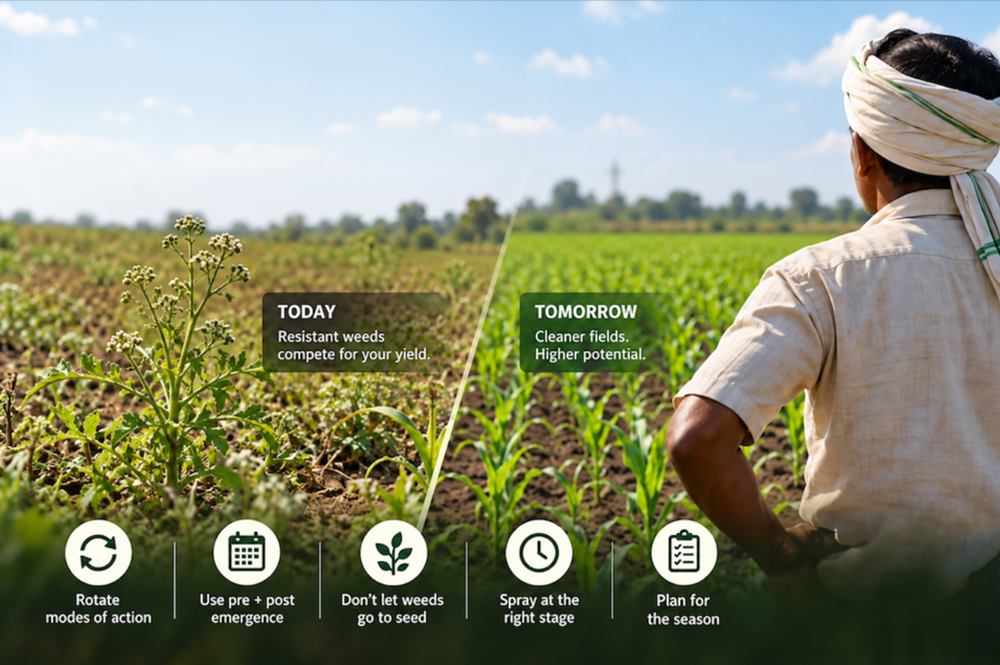
Right Time, Right Dose: Common Application Mistakes That Cost Farmers Yield

GSP Crop Science Blog | For farmers & dealers | 6min read
Mostcomplaints about a crop protection product 'not working' trace back to how itwas applied, not to the formulation itself. A well-tested, correctly registeredproduct can still underperform badly in the field if it meets the crop at thewrong stage, the wrong dose, or the wrong weather window. The same patterns showup again and again across regions and crops.
Spraying at the Wrong Pestor Disease Stage
Timingis often the single biggest factor in how well a product performs. Treating afungal disease only after lesions are already visible and spreading, for instance,is treating a problem that a preventive application earlier in the crop cyclewould have stopped before it started. Many fungicides and some insecticideswork best as preventive or early-stage treatments — waiting for visible damagebefore spraying often means the product is now managing an established problemrather than preventing one.
Wrong Water Volume
Watervolume affects coverage, and coverage affects control. Too little water meansthe spray doesn't reach enough of the leaf surface or pest population to beeffective, even at the correct chemical dose. Too much water, on the otherhand, can dilute the active ingredient below its effective concentration perunit area. The label's recommended water volume per acre or hectare isn't asuggestion — it's calibrated to how that specific formulation is designed towork.
Spraying in the WrongWeather Window
• High heat: causes fast evaporation of the spray solution beforethe active ingredient is fully absorbed, reducing effective uptake.
• Rain shortly after application:can wash off contact-action productsbefore they've had time to work, especially within a few hours of spraying.
• Strong wind: causes spray drift, reducing how much product actuallylands on the target crop and raising the risk of off-target damage toneighbouring fields.
Earlymorning or late afternoon, away from the day's peak heat and typically calmeron wind, tends to give better results for most foliar applications — thoughit's always worth checking the specific product label for any statedexceptions.
Skipping Equipment Checks
Apartially clogged or worn nozzle changes droplet size and spray pattern withoutnecessarily being obvious to the person spraying. The result is uneven coverage— some parts of the field get too much product, others too little — and theoutcome often gets blamed on the product rather than the equipment. A quicknozzle check before a spray session, and periodic replacement as nozzles wear,is a small habit that protects the investment already made in the product itself.
A Quick Pre-Spray Checklist
• Confirm the pest,disease or weed is at the growth stage the label targets — not just that it's'present.'
• Measure water volume perthe label rate, don't estimate by eye.
• Check the weatherforecast for the next few hours, not just the current conditions.
• Inspect nozzles for wearor clogging before starting.
• Spray during earlymorning or late afternoon where the label allows flexibility.
Key takeaway: The dose on thelabel is only half the instruction — the timing and conditions are the otherhalf. Getting both right is usually the difference between a product that'didn't work' and one that did exactly what it was designed to.
Forcrop-specific application guidance, speak with your nearest GSP dealer or fieldrepresentative.